
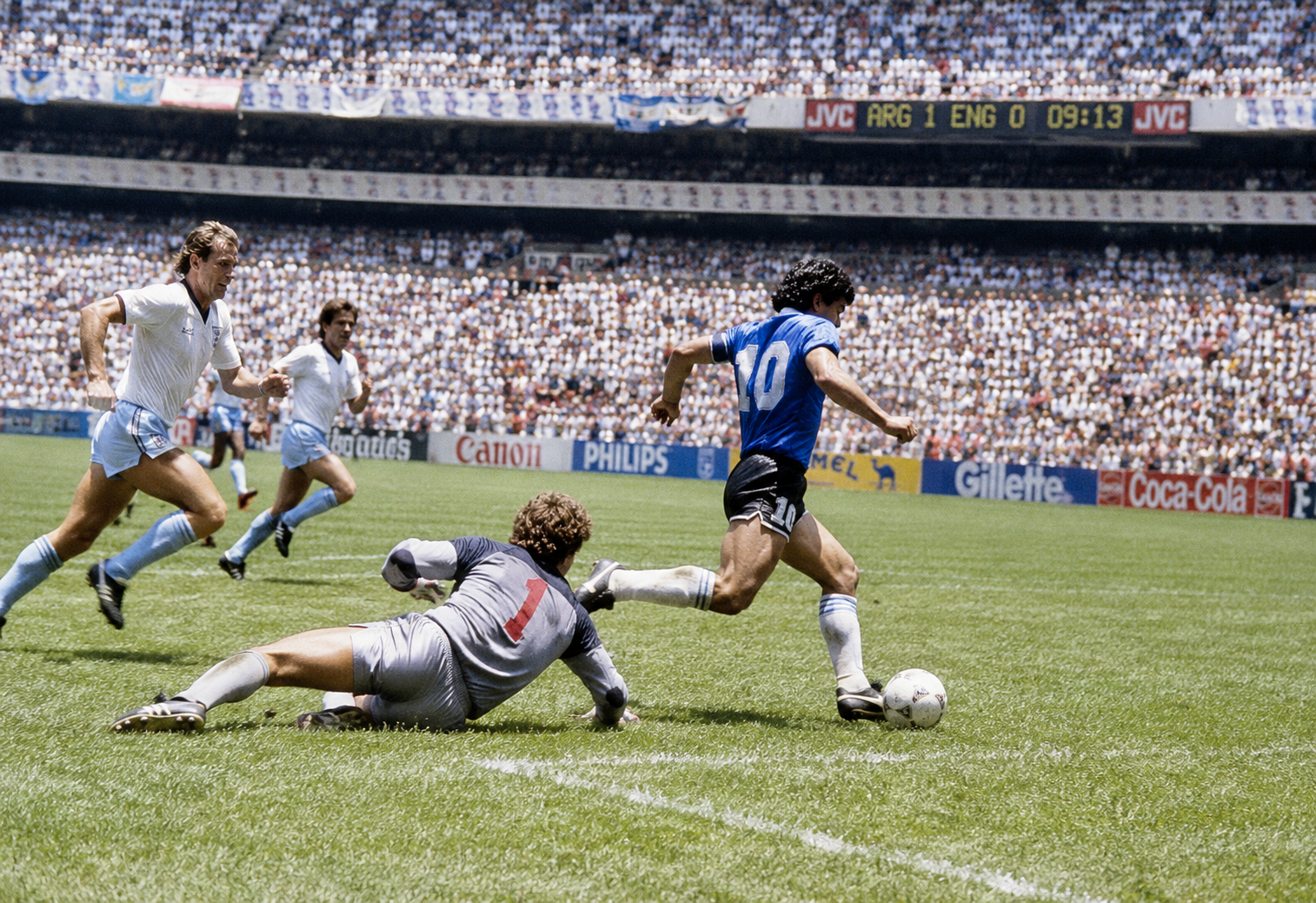
Artistic recreation of an Argentine number 10 dribbling past the England goalkeeper during the legendary second goal of the 1986 World Cup quarter-final. Illustration: The FootIcon.
On July 15, 2026, Argentina vs England delivered another dramatic World Cup encounter when a banner appeared among the celebrations on the pitch: “Las Malvinas son Argentinas.”
Forty-four years had passed since the Falklands War and forty since Diego Maradona scored both the infamous “Hand of God” and the Goal of the Century against England at the Estadio Azteca. Yet once again, football had become the stage where history, memory and national identity collided.
Argentina and England have met only occasionally on the world stage, but few international rivalries carry as much meaning beyond the scoreline. Their encounters have been shaped by brilliant players, controversial moments and a political history that neither side can completely separate from the game.
To understand why a banner about the Malvinas appeared on a football pitch in Atlanta in 2026, we have to go back more than four decades — first to a war in the South Atlantic, and then to one of the most unforgettable matches the World Cup has ever seen.
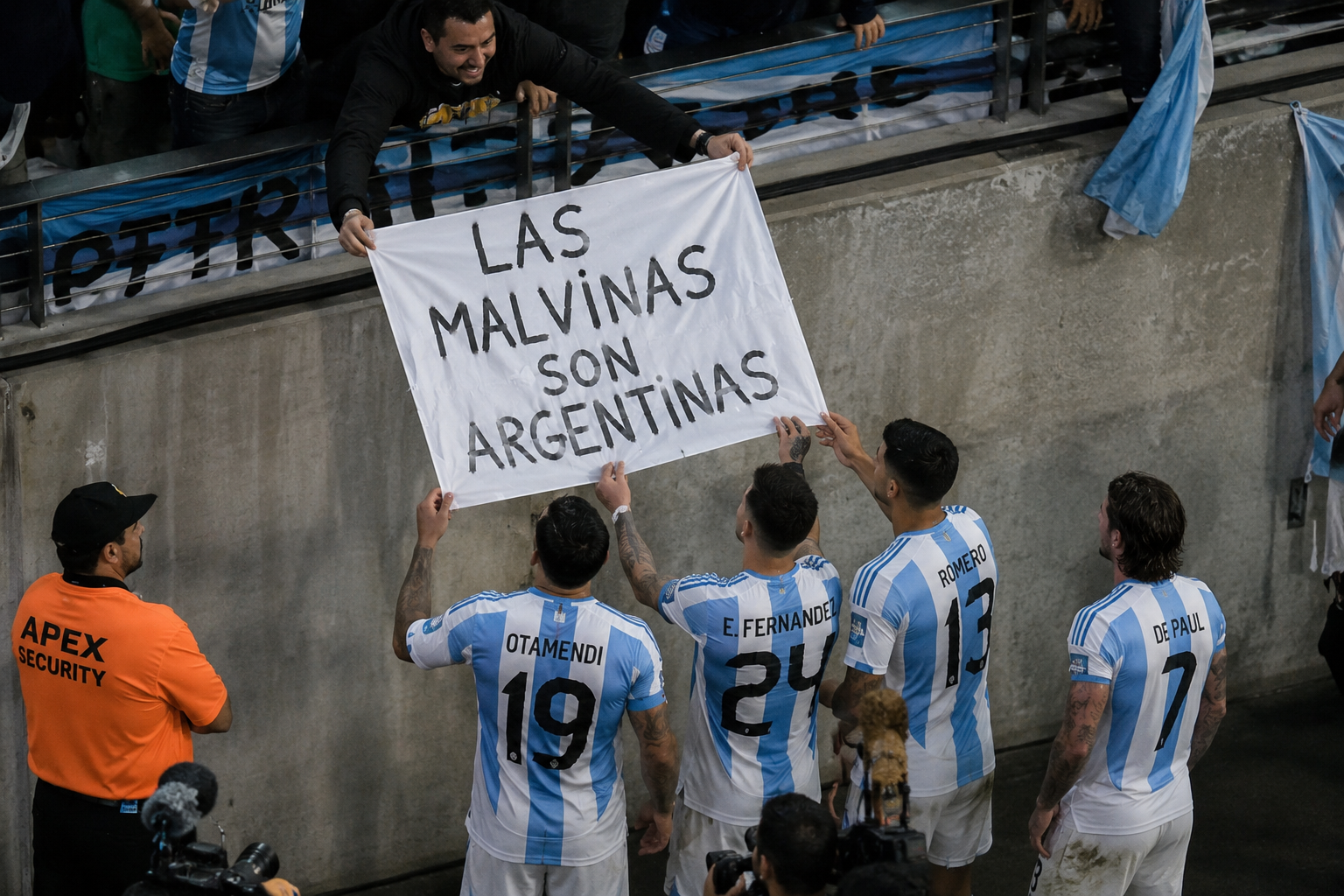
An artistic recreation of Argentine players displaying a banner reading “Las Malvinas son Argentinas,” reflecting how the islands remain part of the football rivalry between Argentina and England.
A War Beyond Football
Four years before Diego Maradona faced England at the Estadio Azteca, Argentina and the United Kingdom had fought a war over a remote group of islands in the South Atlantic — known as the Islas Malvinas in Argentina and the Falkland Islands in the United Kingdom.
On April 2, 1982, Argentine forces landed on the islands, beginning a conflict that would last just over ten weeks. Britain responded by sending a naval task force thousands of miles across the Atlantic. By June, Argentine forces had surrendered and the islands remained under British control.
The war was brief, but its consequences were profound: 649 Argentine military personnel, 255 British military personnel and three Falkland Islanders were killed. In Argentina, the Malvinas became more than a territorial dispute; they became part of the country’s collective memory — a symbol of loss, sovereignty and national identity that would endure long after the fighting ended.
Only four years later, Argentina and England would meet again — this time on a football pitch.
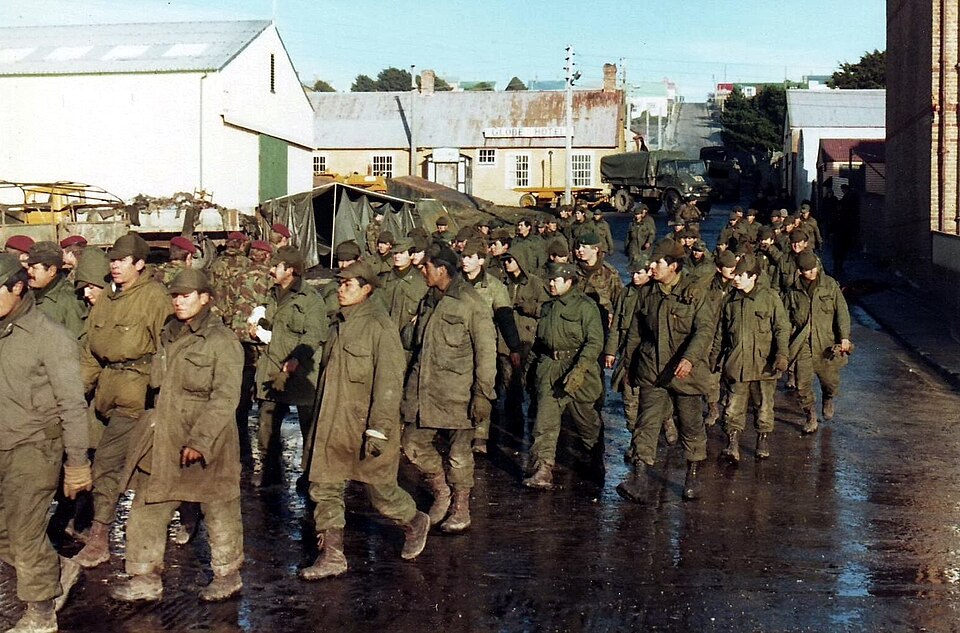
Argentine prisoners of war in Port Stanley following the end of the Falklands War in June 1982. Photo: Ken Griffiths / Public Domain.
Mexico 1986: Argentina vs England
Four years after the Falklands War, Argentina and England found themselves facing each other again — this time in the quarter-finals of the 1986 FIFA World Cup.
On June 22, more than 100,000 spectators filled Mexico City’s Estadio Azteca. The stakes were already enormous: a place in the World Cup semi-finals. But for many watching in Argentina and Britain, the match carried memories that had little to do with football. The players tried to keep the war separate from the game, yet the conflict had ended only four years earlier and hundreds of families were still living with its consequences.
At the centre of it all was Diego Maradona, Argentina’s captain and a player at the height of his powers. Against England, over the course of just a few extraordinary minutes, he would produce two moments so different — one controversial, the other sublime — that together they would define one of the most famous matches in World Cup history.
The first came six minutes into the second half.
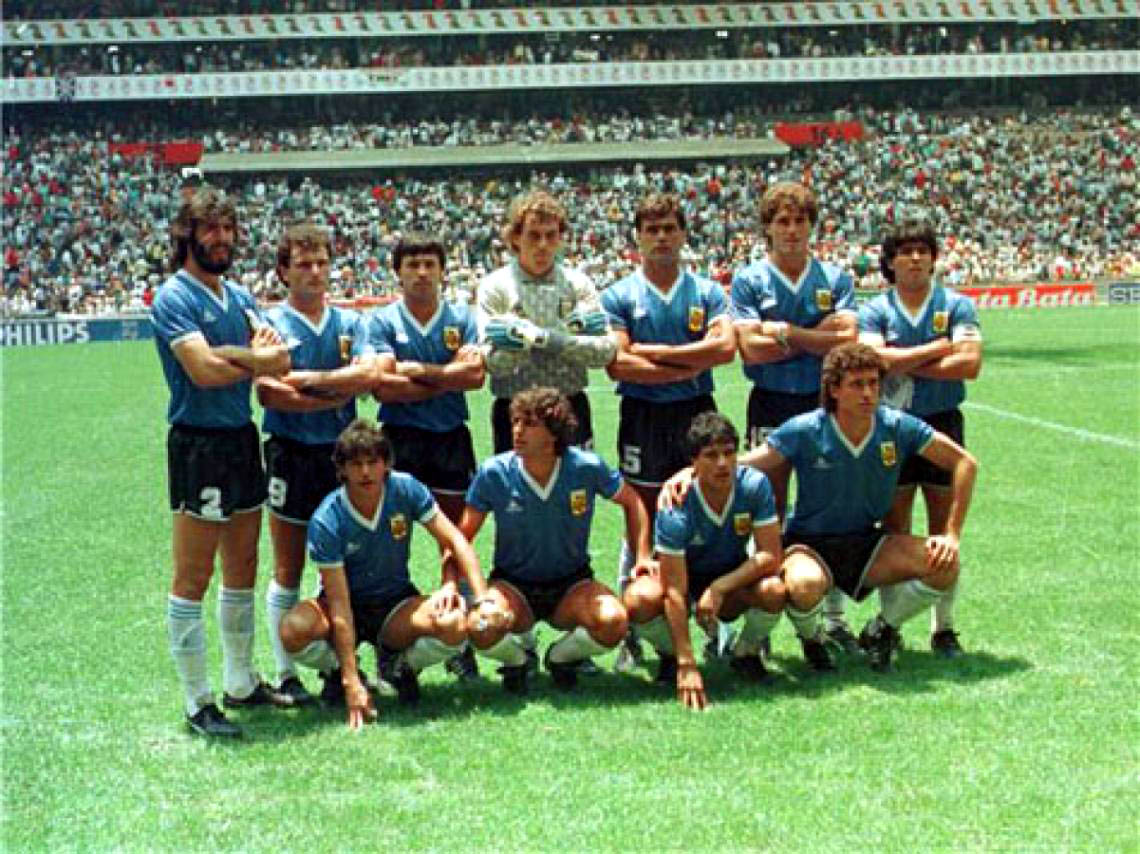
Argentina line up before facing England in the 1986 World Cup quarter-final at the Estadio Azteca on June 22, 1986. Photo: El Gráfico / Public Domain.
The Hand of God
Six minutes into the second half, Maradona drove toward the edge of the English penalty area and attempted a pass that was intercepted by Steve Hodge. But Hodge’s clearance sent the ball looping back toward his own goal, where England goalkeeper Peter Shilton rushed forward to claim it. Maradona, considerably shorter, jumped alongside him — and the ball ended up in the net.
Maradona immediately ran toward the corner to celebrate. Shilton and the English defenders protested, convinced that the Argentine captain had used his hand, but Tunisian referee Ali Bin Nasser allowed the goal to stand. Argentina led 1–0.
After the match, Maradona produced the phrase that would become inseparable from the moment, saying the goal had been scored “a little with the head of Maradona and a little with the hand of God.”
It became one of the most controversial goals in World Cup history. Just four minutes later, Maradona would score one of the greatest.
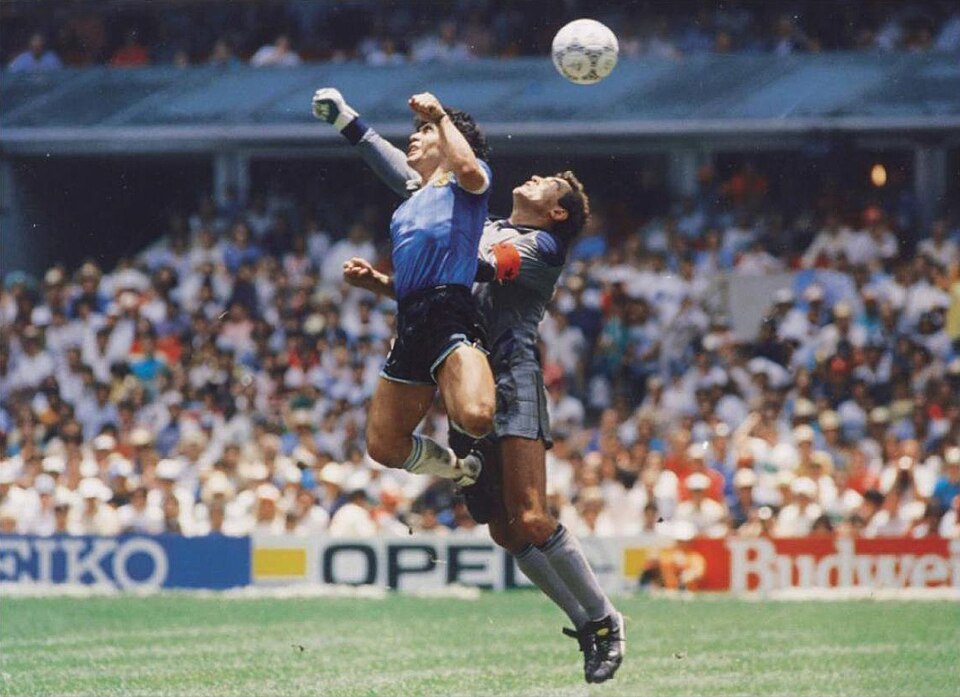
Diego Maradona rises above England goalkeeper Peter Shilton during the controversial “Hand of God” goal in the 1986 World Cup quarter-final at the Estadio Azteca.
Did You Know?
The Argentina–England quarter-final at the 1986 World Cup took place just four years after the Falklands/Malvinas War. Diego Maradona later described the victory as carrying a significance that went beyond football for many Argentines, even though the players knew a football match could never truly compensate for the lives lost in the conflict.
The Goal of the Century
Just four minutes after the Hand of God, Maradona produced something entirely different. He received the ball inside his own half, turned away from Peter Beardsley and Peter Reid, and accelerated toward the English goal.
What followed lasted only seconds. Maradona carried the ball across the pitch, escaping challenge after challenge as England’s defenders tried to stop him. Terry Butcher came across and Terry Fenwick stepped forward, but neither could take the ball away. Maradona then rounded Peter Shilton, kept his balance and finished into the net as Butcher made one final attempt to intervene. Argentina led 2–0.
There was no controversy this time. It was simply an extraordinary individual goal. Years later, in a FIFA poll, the strike would be voted the “Goal of the Century”, becoming one of the defining moments of Maradona’s career and World Cup history.
In the space of four minutes, Maradona had scored two goals that could hardly have been more different: one with his hand, surrounded by controversy; the other with his feet, almost impossible to dispute. England pulled one back through Gary Lineker, but Argentina held on to win 2–1 and advance to the semi-finals.
For Argentina, however, this was never remembered as just another World Cup victory.
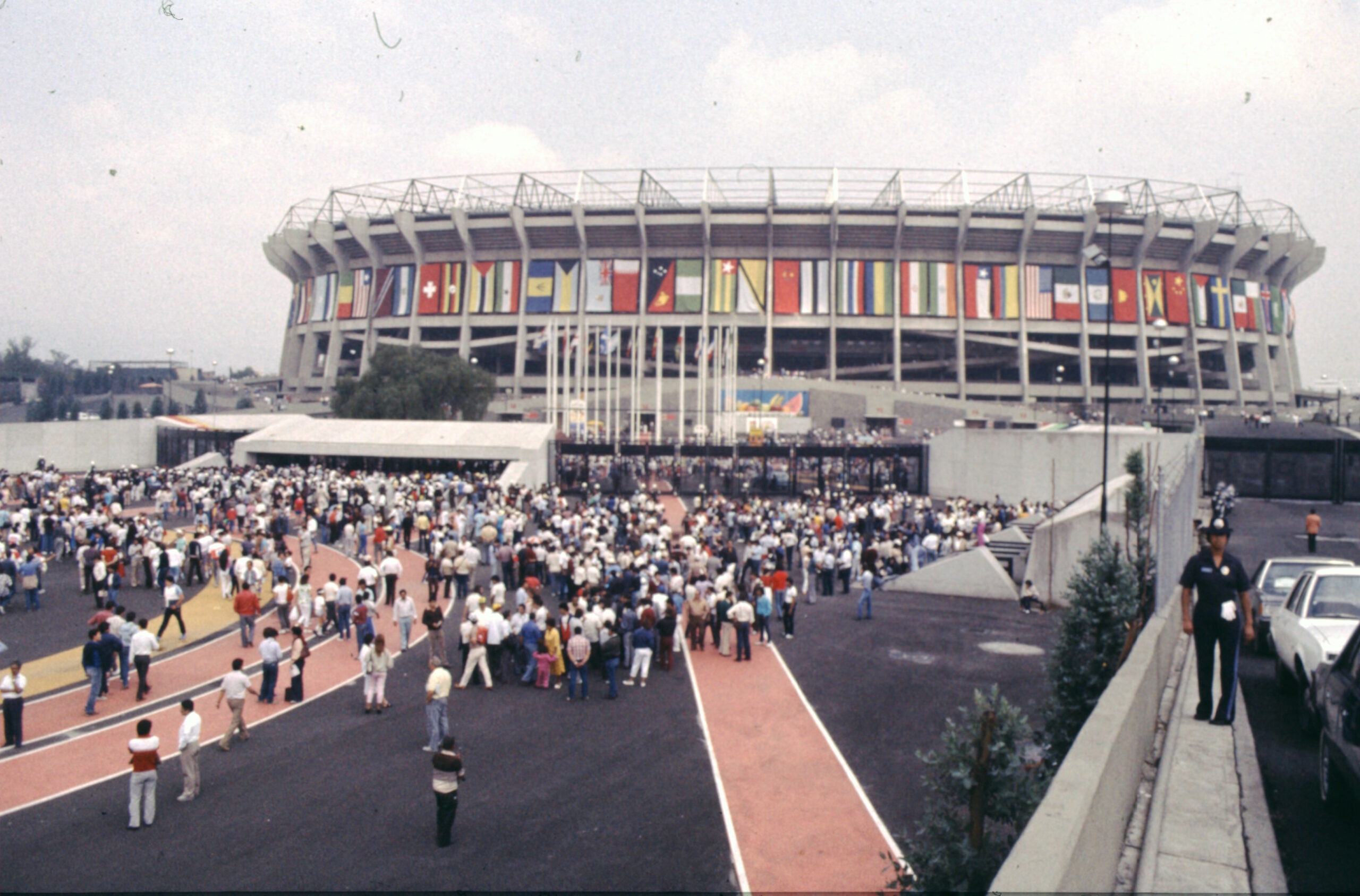
Estadio Azteca during the 1986 FIFA World Cup, the stadium where Maradona scored the Goal of the Century against England. Photo: Karl Oppolzer / CC BY-SA 3.0.
By the Numbers
| Statistic | Number |
| Attendance | 114,580 |
| Final Score | Argentina 2–1 England |
| Maradona goals | 2 |
| Minutes Between Maradona’s Goals | 4 |
| Goal of the Century | 55th minute |
| Time Taken for the Legendary Run | 11 seconds |
| Argentina’s final tournament result | Champions |
More Than Revenge
For the rest of the world, Argentina vs England was an extraordinary World Cup quarter-final. For Maradona, it meant something more. Before the match, both sides publicly tried to separate football from the Falklands/Malvinas War, knowing that no result on a football pitch could undo the deaths or suffering caused by the conflict.
Maradona would later admit that keeping the two worlds apart was almost impossible. He described the victory as a form of “symbolic revenge” against the English and, in later reflections, recalled the young Argentines who had died in the South Atlantic and acknowledged that Malvinas had been on the players’ minds.
That distinction matters. Argentina had not avenged a war by winning a football match, and nothing that happened at the Estadio Azteca could recover the lives lost in 1982. But football can become a place where a nation expresses memories that extend far beyond the game itself, and in Argentina, June 22, 1986 became one of those moments.
Maradona lifted the World Cup eight days later after Argentina defeated West Germany in the final. Yet the victory over England — the Hand of God, the Goal of the Century and everything the match came to represent — remained inseparable from his legend. Like Pelé before him, Maradona had produced a World Cup performance that would define his place in football history.
For decades, the story seemed destined to belong to 1986. Then, forty years later, Argentina and England met again at a World Cup.
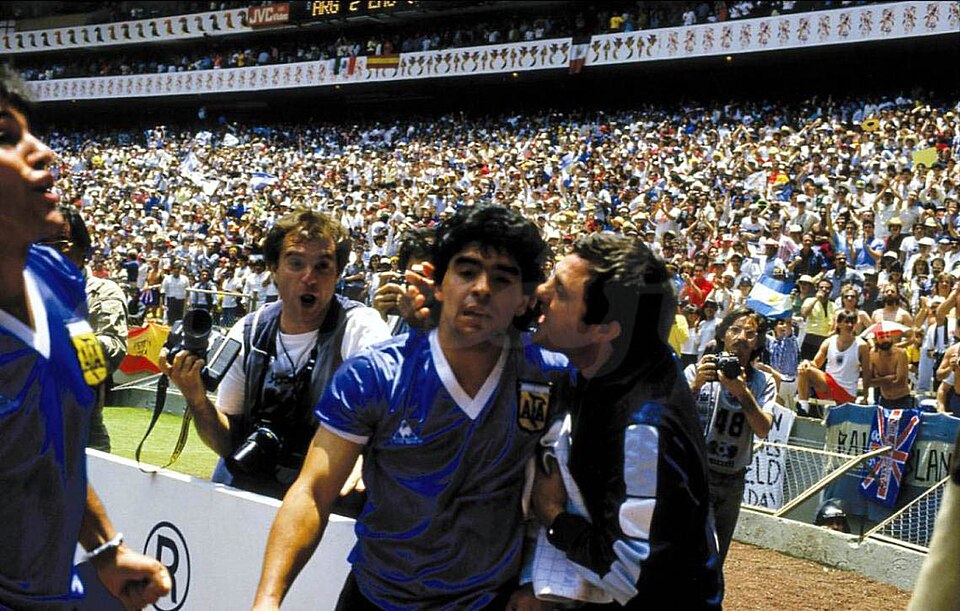
Diego Maradona celebrates during Argentina’s 2–1 quarter-final victory over England at the Estadio Azteca on June 22, 1986, a match that became one of the defining moments of his career.
Forty Years Later
On July 15, 2026, Argentina and England walked onto the same World Cup stage once again, forty years after their unforgettable meeting at the Estadio Azteca. This time, there was no Maradona. The setting was Atlanta, the occasion was a World Cup semi-final, and Argentina arrived as the defending champions.
For much of the match, it seemed England would finally write a different ending. Anthony Gordon opened the scoring in the 55th minute, giving England a 1–0 lead, and as the clock moved toward full time the Three Lions were closing in on their first World Cup final since 1966.
Then Argentina turned the match around. In the 85th minute, Lionel Messi created the opening for Enzo Fernández to equalise. Seven minutes later, deep into stoppage time, Messi provided again and Lautaro Martínez scored. England 1–2 Argentina.
Once again, Argentina had defeated England on the World Cup stage by the same scoreline as in 1986. But what happened after the final whistle transformed the match into something more than another chapter of a famous football rivalry.
As the Argentine players celebrated their place in the World Cup final, a white banner appeared on the pitch. Across it, in large black letters, were four words: “Las Malvinas son Argentinas.”
“Las Malvinas Son Argentinas”
The banner had not been part of an official Argentine celebration. It came from the stands and reached the pitch as the players celebrated in front of their supporters. Lisandro Martínez and Giovani Lo Celso were among those who held it up, turning four words written on a piece of white fabric into one of the defining images of the night.
The message was unmistakable: “Las Malvinas son Argentinas” — “The Malvinas are Argentine.” The gesture quickly travelled far beyond the stadium.
The British government called for FIFA to investigate the incident, arguing that political messages had no place on the pitch. FIFA regulations restrict political and ideological messages at matches, placing the celebration under scrutiny.
In Argentina, however, the banner carried a very different resonance. It connected a new generation of players and supporters with a dispute that had existed long before any of them wore the national shirt. Appearing immediately after another World Cup victory over England, it inevitably drew comparisons with 1986.
Forty years earlier, Maradona had spoken of the emotions surrounding Malvinas after producing one of football’s most extraordinary performances. In 2026, the message was no longer hidden beneath the football — it was written across a banner for the world to see.
From Atlanta to Tierra del Fuego
The story of the banner did not end in Atlanta. Weeks after the World Cup, the Argentine Football Association declared July 15 — the date of the victory over England — the National Day of Argentine National Teams. AFA president Claudio Tapia also announced plans for the banner to be donated to a museum connected to the Falklands/Malvinas War in Tierra del Fuego.
What had begun as a handmade message in the stands had crossed onto the pitch, travelled around the world through photographs and television, and was now being transformed into an object of memory.
The journey was symbolic: from a war in the South Atlantic in 1982, to a football pitch in Mexico in 1986, to another World Cup in Atlanta forty years later, the same history continued to surface in different forms.
The Match That Never Ended
Football did not settle the Falklands/Malvinas dispute in 1986, and it did not settle it in 2026. No victory, goal or banner can erase the human cost of a war. But football has an extraordinary ability to carry memory.
For Argentina and England, that memory has followed their encounters across generations. It was there when Maradona rose beside Peter Shilton, four minutes later when he produced the Goal of the Century, and forty years later when it appeared again on a white banner in Atlanta.
The players changed, the stadiums changed and the World Cup changed. The history remained.
Perhaps that is why Argentina vs England has never felt like just another football match. Some matches end with the final whistle; others continue long after it.
The FootIcon Editorial Team
Preserving football’s greatest stories for future generations.