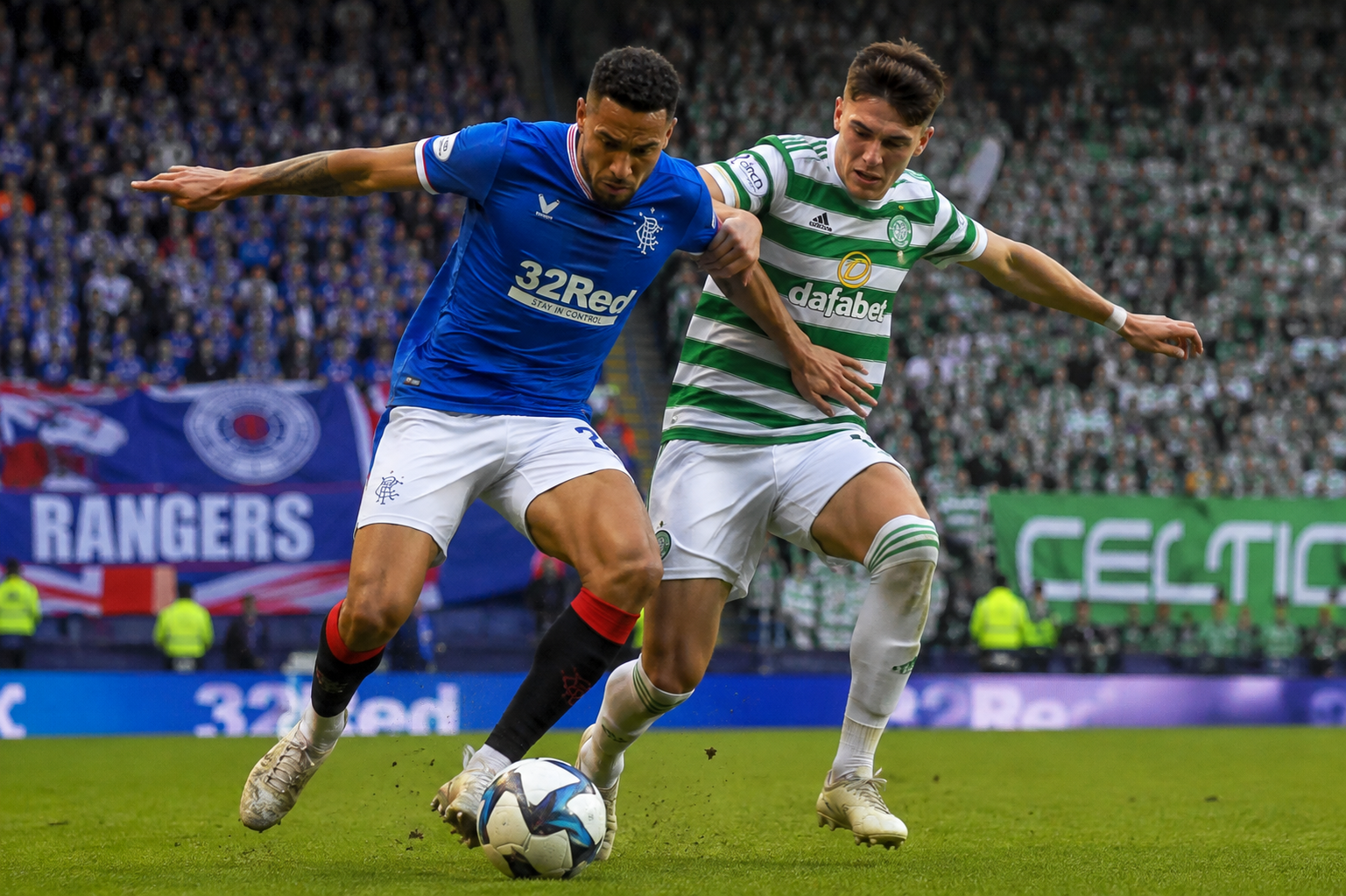
Rangers and Celtic players battle for possession in an artistic recreation of the Old Firm, one of football’s fiercest and most historic rivalries. Illustration: The FootIcon.
In Glasgow, football can mean far more than ninety minutes. When Rangers and Celtic meet, the city turns blue, green and white. Ibrox and Celtic Park become the centres of two footballing worlds separated by only a few miles — and connected by more than a century of rivalry.
Known as the Old Firm, Rangers vs Celtic is one of the most intense and complex rivalries in world football. Its story reaches far beyond trophies, famous players and dramatic matches. Over generations, the two clubs became associated with different communities, religious traditions and political identities, giving the rivalry a significance that extends well beyond the pitch.
Yet it did not begin with hatred. When Celtic played the first match in their history in 1888, the opponent was Rangers. What followed would transform two Glasgow football clubs into institutions followed by millions and turn their meetings into some of the most emotionally charged occasions in the sport.
To understand how Rangers vs Celtic became the rivalry that divided Glasgow, we have to return to the late nineteenth century — and to the very different origins of the two clubs.
Rivalry Profile
| Rangers | Old Firm | Celtic |
| 172 | Competitive Wins | 173 |
| 5–0 | Biggest Competitive Win | 7–1 |
| 1893 | Year of Biggest Win | 1957 |
| 55 | Scottish League Titles | 56 |
| Ibrox | Home | Celtic Park |
| 1872 | Founded | 1887 |
Two Clubs, One City
Rangers and Celtic share Glasgow, but they did not begin in the same place, at the same time or for the same reasons.
Rangers came first. The club traces its origins to 1872, when four young men — Moses McNeil, Peter McNeil, Peter Campbell and William McBeath — formed a football team after meeting at Glasgow Green. There was no grand stadium, wealthy owner or political cause behind them. What began as a group of young men playing football would eventually grow into one of Scotland’s most successful clubs.
Celtic emerged fifteen years later from a very different Glasgow. During the nineteenth century, large numbers of Irish immigrants had settled in the city’s East End, many living in severe poverty. In 1887, Brother Walfrid, an Irish Marist Brother, helped establish Celtic Football Club with a charitable purpose: raising money to provide food for poor children in the local community.
The two clubs were therefore born from different circumstances: Rangers grew from football itself, while Celtic grew from football and community. On May 28, 1888, those two stories met for the first time when Celtic played their first official match against Rangers at the original Celtic Park. The new club won 5–2.
Nobody could have known what that afternoon would eventually become. Two clubs from the same city had met for a game of football; they were about to build a rivalry that would last for generations.
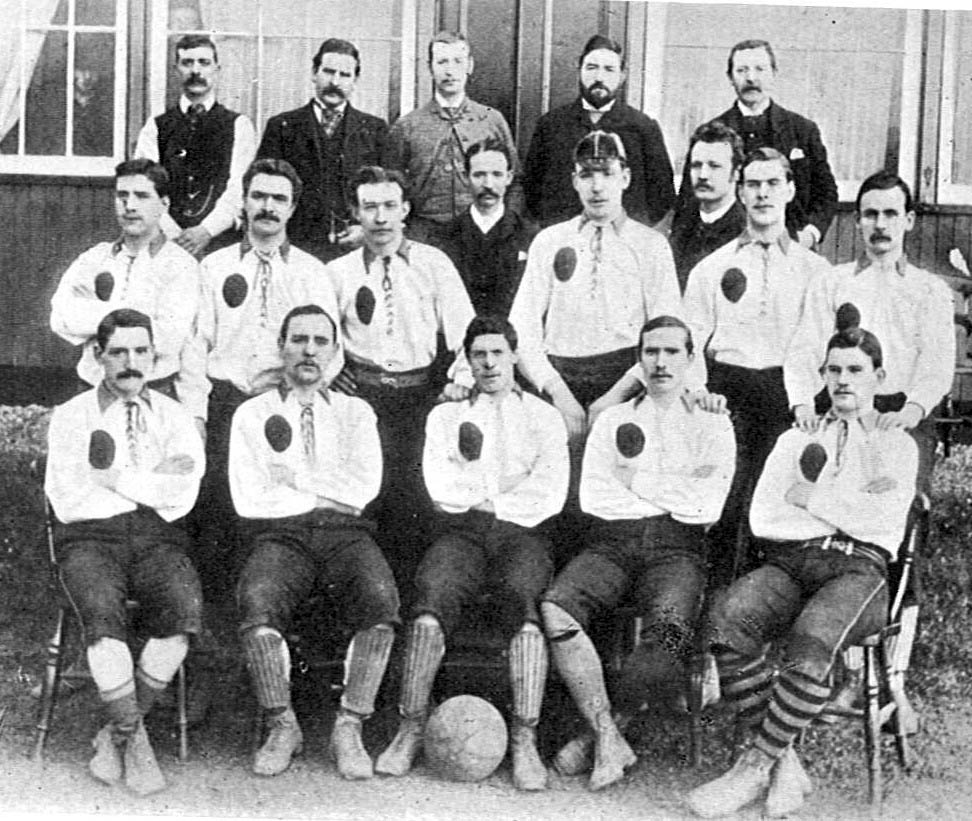
The Celtic FC team in 1888, the year the club played its first match — a 5–2 victory over Rangers. Photo: Unknown / Public Domain.
The Birth of Celtic and the Origins of the Rivalry
Celtic’s first meeting with Rangers gave little indication of the hostility that would eventually define the fixture. What began as a friendly encounter soon changed as Celtic rapidly developed from a charitable football project into one of Scotland’s strongest clubs.
The club attracted talented players and built a large following among Glasgow’s growing Irish community. Within a few years, Celtic were challenging Rangers for trophies and influence, turning two clubs separated by only a few miles into direct rivals for supremacy in Scottish football.
Their rivalry grew alongside Glasgow itself. The city was expanding rapidly, shaped by industry, migration and deep social divisions. Celtic’s connection with the Irish Catholic community gave the club an identity that extended beyond football, while Rangers increasingly became associated with Glasgow’s Protestant community and, over time, British unionist identity.
Those associations did not appear overnight, nor did every supporter fit neatly into one side or the other. But by the early twentieth century, Rangers and Celtic represented increasingly distinct footballing communities, and the Old Firm was becoming something much bigger than a derby.
Religion, Identity and Politics
To understand the Old Firm, it is not enough to look at football. Celtic’s roots were deeply connected to Glasgow’s Irish Catholic community, and for many immigrants and their descendants the club became an expression of heritage and belonging. Irish flags, songs and symbols became part of its supporter culture, while sections of the support developed connections with Irish nationalism and republicanism.
Rangers developed a different identity, becoming strongly associated with Glasgow’s Protestant community and British unionism. The contrast became increasingly visible: green and white against blue, the Irish tricolour against the Union flag, Irish nationalism against British unionism.
Religion was intertwined with those identities, but the Old Firm was never simply a disagreement between Catholics and Protestants. Migration, ethnicity, politics and competing ideas of national belonging also shaped the divide. As with Argentina and England, football can become a stage where history, politics and national identity collide.
For much of the twentieth century, Rangers maintained an unwritten practice of not knowingly signing Catholic players, one of the most controversial symbols of the divide surrounding the club. Celtic did not operate an equivalent policy excluding Protestant players. These identities became deeply embedded in supporter culture, passed through generations by families, neighbourhoods, flags and songs.
The rivalry also became associated with sectarianism — hostility or discrimination based on religious or communal identity. At different moments, sectarian language, discriminatory behaviour and violence carried the divide beyond the pitch. But that history does not mean every Rangers supporter is Protestant, every Celtic supporter is Catholic, or that every fan embraces the political traditions associated with either club.
Modern Glasgow is far more complex. A Scottish Government survey found that 56% of Rangers supporters surveyed identified as Protestant and 56% of Celtic supporters as Catholic, while substantial numbers on both sides identified with neither traditional religious label. The historical connection remains visible, but it does not define every supporter.
More than a century after their first meeting, traces of that history can still be seen and heard when Rangers and Celtic meet. An Old Firm match can still carry questions of religion, ancestry and national identity into a football stadium — turning a rivalry into something more than football.
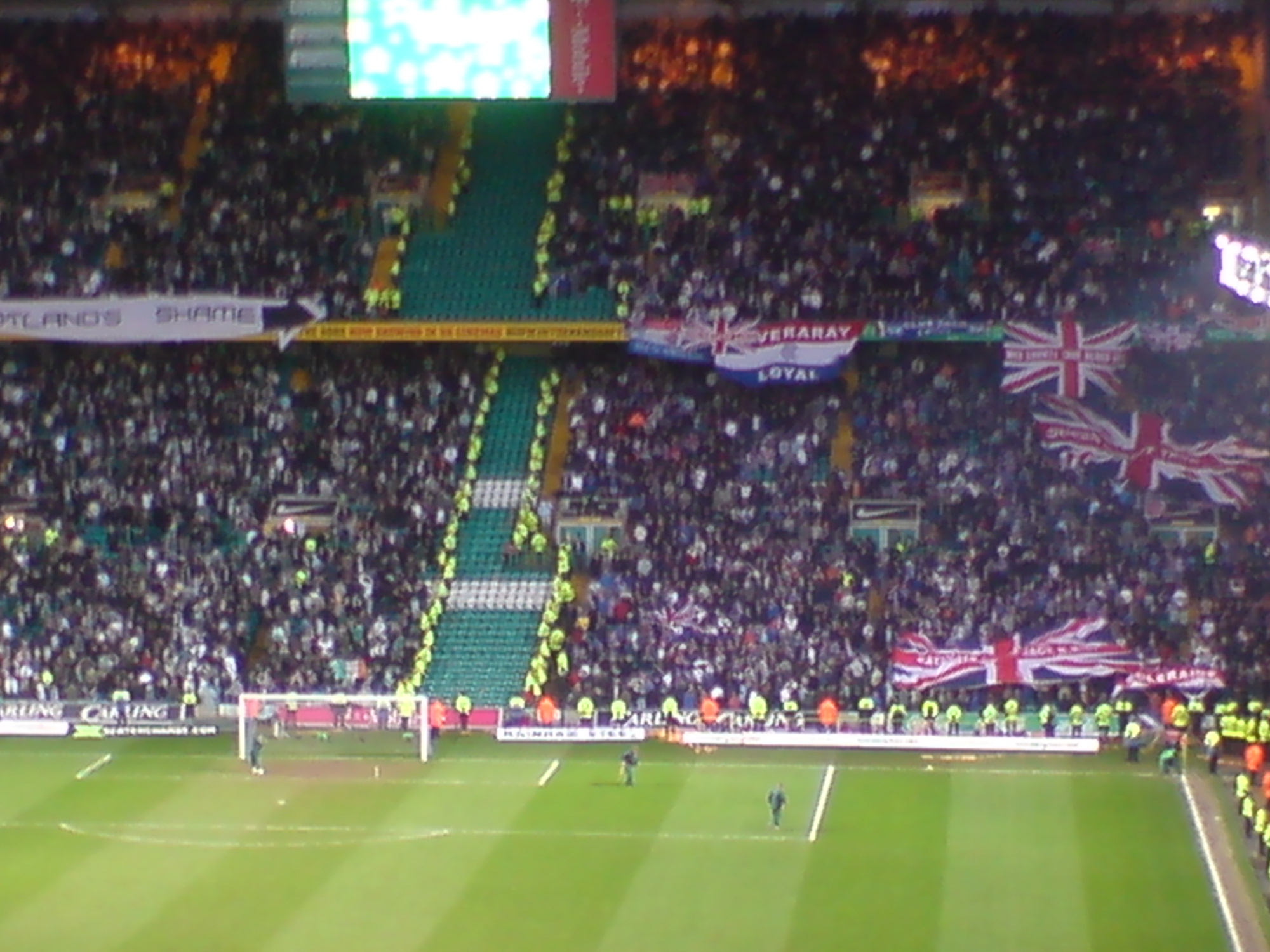
Supporters of Celtic and Rangers display their colours during an Old Firm derby at Celtic Park in Glasgow. Photo: Mark Sheffield / CC BY-SA 1.0.
Did You Know?
In 1939, 118,567 spectators packed Ibrox to watch Rangers defeat Celtic 2–1 — a crowd that remains the British record for a league match. The attendance was more than twice the capacity of modern Ibrox, showing just how enormous the Old Firm had already become before the Second World War.
When Football Became More Than Football
For generations, the Old Firm has produced extraordinary football, but some of its most memorable moments have had little to do with the ball. As Rangers and Celtic became dominant forces in Scotland, their meetings attracted enormous crowds and increasingly intense emotions. Victory could mean more than points or trophies; defeat could feel personal, tied to identity, community and belonging.
One of the earliest warnings came in 1909, when Rangers and Celtic met in the Scottish Cup final. The first match ended in a draw, as did the replay. Many supporters expected extra time, but officials instead ordered another replay. Thousands poured onto the Hampden Park pitch, barriers were torn apart, fires were started and police struggled to restore order. The Scottish Football Association eventually abandoned the competition without declaring a winner.
Remarkably, the violence that day was not primarily Rangers supporters fighting Celtic supporters. Contemporary accounts suggest fans from both sides were united in anger at the football authorities, believing another match was being arranged simply to generate more gate money.
Seven decades later, Hampden witnessed something very different. On May 10, 1980, Celtic defeated Rangers 1–0 after extra time to win the Scottish Cup. After the final whistle, supporters entered the pitch and rival groups began confronting each other. Hundreds fought on the Hampden turf as bottles and cans were thrown and mounted police moved in to restore order. More than 200 arrests were eventually made in the Hampden area.
The disorder became a major factor in Scotland banning the sale of alcohol at football grounds, and the consequences reached beyond the Old Firm into policing, public debate and government policy.
Yet incidents like these do not define every Rangers or Celtic supporter. For millions, the Old Firm is a family tradition built around attending matches, celebrating victories and passing allegiance from one generation to another. That contradiction is central to the rivalry: at its best, it produces colour, noise and an atmosphere few matches can reproduce; at its worst, it shows how easily football can become a stage for conflicts that began somewhere else.
The game lasts ninety minutes. The identities surrounding it do not.
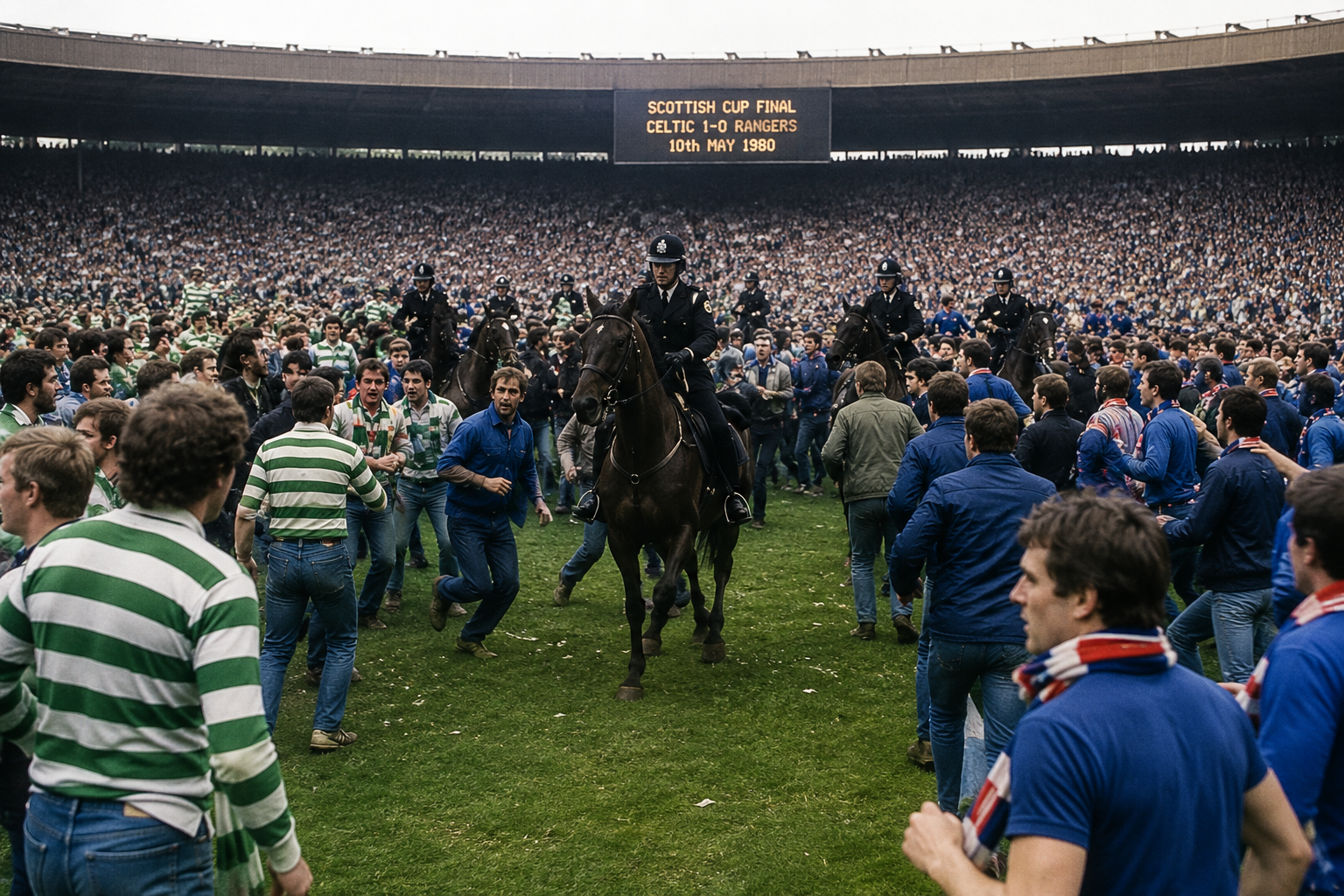
Artistic recreation of the disorder that followed the 1980 Scottish Cup Final between Celtic and Rangers at Hampden Park, when supporters entered the pitch and mounted police intervened. Illustration: The FootIcon.
The Players Who Crossed the Divide
In most football rivalries, playing for both sides guarantees controversy. In the Old Firm, crossing the divide could mean something far greater.
Only a small number of players in the modern era have represented both Rangers and Celtic. Alfie Conn played for Rangers before joining Celtic in 1977, while Kenny Miller later followed an even more unusual path: Rangers, Celtic — and then Rangers again. But no player crossed the divide quite like Maurice “Mo” Johnston.
Johnston had starred for Celtic between 1984 and 1987 before leaving Scotland for Nantes. Two years later, a return to Celtic appeared to be on the way. Instead, on July 10, 1989, he signed for Rangers in one of the most shocking transfers in Scottish football history.
For Celtic supporters, the sense of betrayal was enormous. But Johnston’s arrival carried an even deeper significance: he was Catholic. Rangers had maintained an unwritten practice of not knowingly signing Catholic players for much of the twentieth century. Catholics had represented the club before Johnston, so describing him as Rangers’ first Catholic player would be inaccurate, but his status as a high-profile signing made the transfer a watershed moment.
The reaction came from both sides. Some Rangers supporters opposed the signing because of Johnston’s religion and his Celtic past, while Celtic supporters saw a former hero joining the one club they could never accept him joining.
Only months later, Johnston added another chapter by scoring a late Old Firm winner against Celtic at Ibrox. Rangers won 1–0. A player who had once scored in green and white was now deciding the derby in blue.
Other players would represent both clubs, but few transfers have exposed the history and contradictions of the Old Firm as dramatically as Johnston’s move in 1989. He did not simply change clubs; he crossed a line that, for generations, many believed should never be crossed.
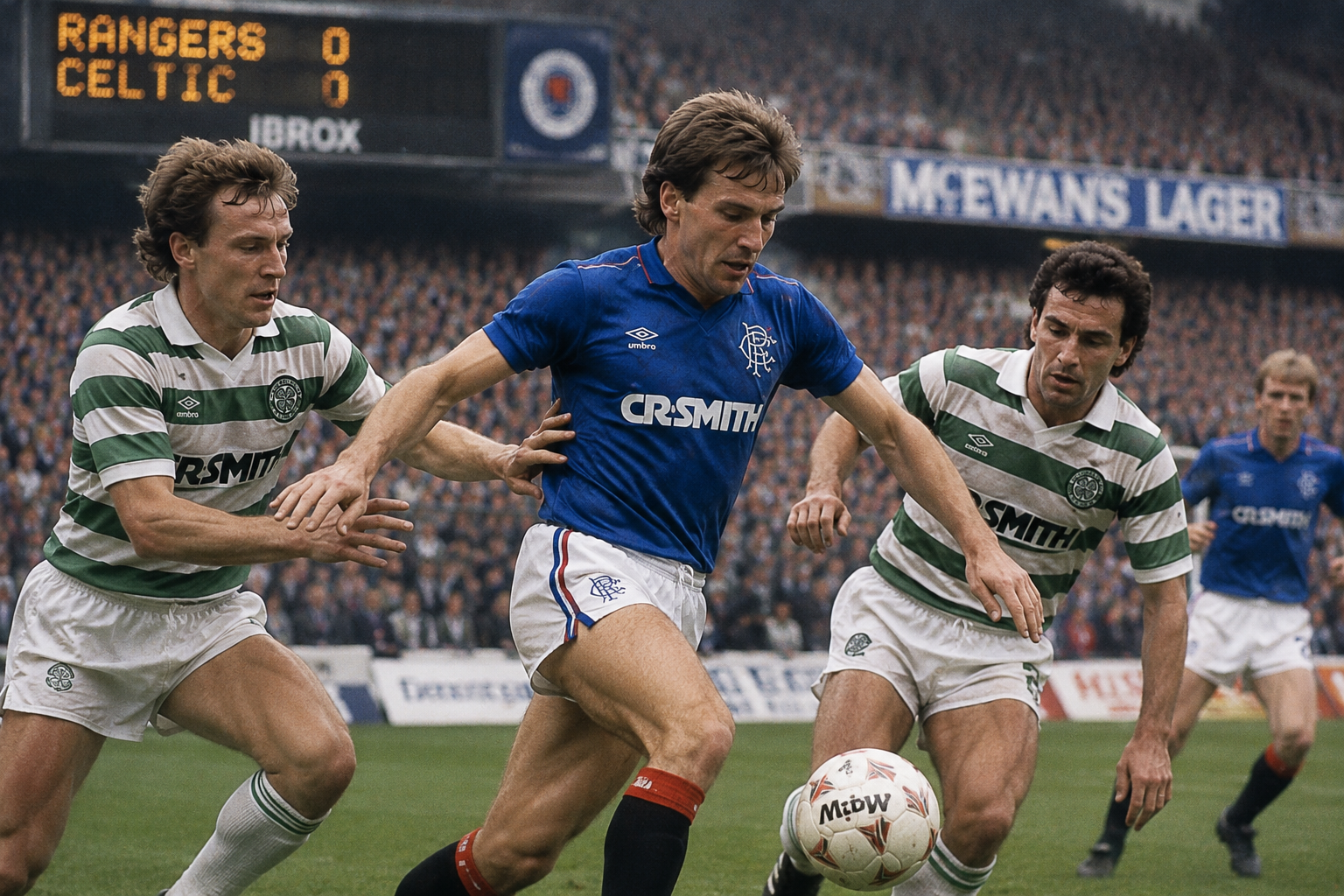
Artistic recreation of an Old Firm clash at Ibrox in the late 1980s, an era marked by one of the rivalry’s most controversial transfers: Mo Johnston’s move from former Celtic hero to Rangers player in 1989. Illustration: The FootIcon.
2012: Rangers Fall and Return
For more than a century, Rangers and Celtic had defined Scottish football together. Then, in 2012, one half of the Old Firm disappeared from the top flight.
Rangers entered administration in February amid a severe financial crisis. Attempts to rescue the company failed, and the company that operated the club entered liquidation. Rangers’ business and assets were subsequently purchased by a new company led by Charles Green, but there would be no immediate return to the Scottish Premier League.
In July 2012, Rangers were placed in the fourth tier of Scottish football, then known as the Third Division. Suddenly, one of the country’s dominant clubs was travelling to grounds far removed from the stages on which it had spent most of its history. For Celtic, the league continued without their greatest rivals, removing the Old Firm from the regular calendar for the first time in generations.
Rangers began the long climb back. They won the Third Division in their first season, earned another promotion the following year and, after missing out in the 2015 play-offs, won the Scottish Championship in 2016 to return to the top flight.
The Old Firm itself had already returned. On February 1, 2015, Rangers and Celtic met in the Scottish League Cup semi-final at Hampden Park, their first competitive encounter in almost three years. Celtic won 2–0.
Returning to the Premiership did not immediately restore Rangers to the summit. Celtic continued their domestic dominance until 2020–21, when Steven Gerrard’s Rangers ended their run of nine consecutive league championships. Rangers finished the league season undefeated with 102 points, securing their 55th league title.
Nine years after the crisis of 2012, Rangers were champions of Scotland again. The Old Firm had survived financial collapse, a journey through the divisions and years without a league meeting — and the battle for Glasgow resumed.
Rangers vs Celtic: The Old Firm Today
More than 135 years after their first meeting, Rangers and Celtic still dominate the football landscape of Glasgow. The stadiums are modern, players arrive from around the world and Scottish society is very different from the city in which the rivalry was born. Yet when the clubs meet, the sense of separation remains. Celtic Park and Ibrox stand only a few miles apart, but on derby day they can feel like the centres of two different footballing worlds.
Green and white against blue remains an unmistakable part of Glasgow’s football culture. Flags, songs and symbols still carry traces of the identities that shaped generations of supporters, even as both fanbases have become broader and more diverse.
The modern rivalry has produced different disputes. For years, disagreements over ticket allocations dramatically reduced — and at times eliminated — travelling support from league derbies. Away supporters returned in 2025, with reciprocal allocations of around four percent of saleable capacity, although ticketing remained contentious into 2026.
Even the name of the rivalry is disputed. Rangers vs Celtic has long been known around the world as the Old Firm, but after Rangers’ financial collapse in 2012, sections of the Celtic support rejected the term, arguing that the original Old Firm had ceased to exist. Rangers supporters strongly dispute that interpretation and regard the club and its history as continuous.
Perhaps that disagreement says something about Rangers and Celtic: they can argue not only about matches, trophies and players, but even about what their rivalry should be called. Whatever the name, more than a century after their first meeting, Glasgow still turns green, white and blue whenever the two sides meet.
A Rivalry Like No Other
Rangers and Celtic began as two football clubs in the same city, born fifteen years apart and for very different reasons. More than a century later, they have become inseparable from the history of Glasgow and Scottish football.
The Old Firm has produced extraordinary matches, enormous crowds and a relentless battle for trophies, but its significance has always extended beyond results. Immigration, religion, identity and politics became intertwined with the cultures surrounding the clubs, creating traditions — and divisions — passed through generations.
That history should neither be romanticised nor reduced to simple labels. The rivalry has created unforgettable atmospheres and lifelong traditions, but it has also been accompanied by sectarianism, discrimination and violence. Modern Rangers and Celtic are global clubs with supporters from different countries, religions and backgrounds, yet echoes of their history remain whenever blue meets green and white.
That is what makes Rangers vs Celtic difficult to compare with almost any other derby. Players change, managers leave and generations of supporters come and go, but the rivalry continues to carry the history of the city that created it.
Two clubs. One city. More than a century of rivalry. The Old Firm endures.
The FootIcon Editorial Team
Preserving football’s greatest stories for future generations.